A medical clearance isn't anesthesia clearance.
Their PCP already said yes. Anesthesia still hasn't looked — and in most practices the first real anesthesia look happens the morning of surgery, at the door. That's where cancellations are born. VeriOp runs the anesthesia clearance on every chart before surgery day, so problems get fixed on the schedule — not in pre-op holding with the room staffed and the patient in a gown.
Every case, verified.
Run a real clearance. See the verdict in 30 seconds.
Use our sample case or paste your own de-identified chart.
The labs were done. Nobody with the anesthesia hat on had read them.
A healthy 21-year-old, scheduled for a breast augmentation. No medical history. The surgical team ran labs but skipped the anesthesia review — because why would a healthy 21-year-old need one? The morning of surgery, the anesthesia team opened the chart for the first time and found a TSH of 13 — an undiagnosed thyroid disorder. Case cancelled. Patient in a gown, OR staffed, morning gone.
The cruelest part? The answer had been sitting in the chart for weeks. Reading every chart, for every patient, at all hours doesn't scale for humans — so in most practices it simply doesn't happen until the day of surgery.
A medical clearance doesn't mean cleared for anesthesia. Anesthesia can still cancel the case at the door — and it happens to “cleared” patients all the time.
VeriOp reads everything the moment it lands — the TSH of 13, the missing EKG on the 55-year-old, the GLP-1 nobody held — and flags it while there's still time to fix the schedule instead of losing the morning.
Safety isn't a side effect. It's the whole point.
VeriOp.ai applies the same clinical reasoning a board-certified anesthesiologist would — ASA Physical Status, ACC/AHA cardiovascular criteria, ASRA anticoagulation timing — to every clearance, before the patient is in the chair. Built by an anesthesia provider. Trained on real anesthesia cases. The cost savings are real. The safety upgrade is bigger.
- Anesthesia-grade clinical review on 100% of cases
- Catches the miss upstream — weeks before surgery, not at 7am
- Documented clinical-grade review in every chart
- Validated on 1268 real cases · 123 cancellations prevented
And here's how it pays for itself.
Patient safety improvements come standard. On top of that, at $299/month (~$3,588/year for your whole practice) Surgeon Practice pays back three concrete ways — before the end of your first month.
Save money by cutting anesthesia pre-op time from 30 minutes to 5.
Your anesthesia provider spends 30 minutes on a pre-op today. With VeriOp.ai's auto-populated Pre-Op Form, that drops to 5 minutes or less. Do the math on 3 pre-ops a day, across multiple providers — it pays for itself.
= 312 hrs/yr per provider
At $150/hr CRNA – $350/hr MD anesthesia all-in rate. For a 4-provider group, that's $187K–$437K/year recovered.
Stop being the on-call reviewer for your coordinator.
Is your coordinator constantly chasing you — to review PCP clearance letters, ask which meds the patient should hold, or flag a borderline ASA 2/3 for outpatient surgery? VeriOp.ai does the heavy lifting. Built by anesthesia, it reviews each case the way an anesthesia provider would. Catch issues weeks before surgery, not at 7am. Spend your time on the OR — and going home to your family — not on clearance triage.
= ~21 hrs/month of coordinator time
Coordinator math at $25–$30/hr. Your reclaimed surgeon-attention isn't in the dollar figure — it's the bigger win.
1 in 10 cases would have been cancelled day-of.
The miss almost always happens upstream — at clearance review, by someone whose training isn't qualified to catch and make medical decisions, relying on a checklist. Even medical professionals occasionally miss things. VeriOp.ai won't. Catch the problem weeks before surgery — not at 7am with the OR set up and the patient on the table.
= $70K–$168K avoided per year
Catch rate: 123 of 1268 clearances reviewed had findings that would have caused same-day cancellation or significant delay. Cancellation cost: Dexter, ASA/APSF, Argo et al.
Safer patients. Lower overhead. Pays for itself in one month.
You don't need all three ROI buckets to break even — any one of them covers it. And the thing you can't put a dollar on — knowing every clearance got an anesthesia-grade clinical read — comes standard.
You've already lived every one of these.
Clearances arrive in pieces, over weeks.
The coordinator chases the PCP for the H&P, then the lab, then the EKG, then the cardiology note — and every time something new comes in, someone has to re-read the whole packet. Nobody with anesthesia training is reading the pile as it grows — not because anyone's careless, but because that job never scaled for humans.
The day-of cancellation that ruins everyone's day.
Hemoglobin too low. GLP-1 wasn't held. Anticoagulation timing off. By the time you catch it, the room is set up and the case is done. The center loses $5,800–$14,000 per case (Dexter et al, ASA/APSF, Argo et al). One a month is a coordinator's salary.
The liability that lands on you anyway.
The coordinator who reviewed the chart wasn't trained for this. The PCP isn't in the room. When something gets missed and the case goes sideways, the documentation doesn't say “the front desk approved it.” It says the anesthesia provider gave the go-ahead.
The risk you actually carry: a non-clinical person making clinical calls.
Look at your last ten cancellations. Trace each one back. The miss almost always happened upstream — at the clearance review stage, by someone whose training did not include reading an EKG, interpreting a CMP, or catching a medication interaction. That's not a critique of your coordinator. It's a structural problem: clinical judgment shouldn't sit with non-clinical staff.
VeriOp.ai is the second-reader you didn't have. It applies the same clinical reasoning a board-certified anesthesiologist would apply — ASA Physical Status, ACC/AHA cardiovascular criteria, ASRA anticoagulation timing — to every clearance, before the patient is in the chair. It's not replacing your judgment. It's making sure your judgment isn't the only line of defense.
“It was never your coordinator's job to make clinical calls. Now it doesn't have to be.”
Three steps. About thirty seconds.
Run it the moment a clearance lands in your inbox.
Attach the patient's docs.
Click "Analyze."
Get the verdict + a real PDF report.
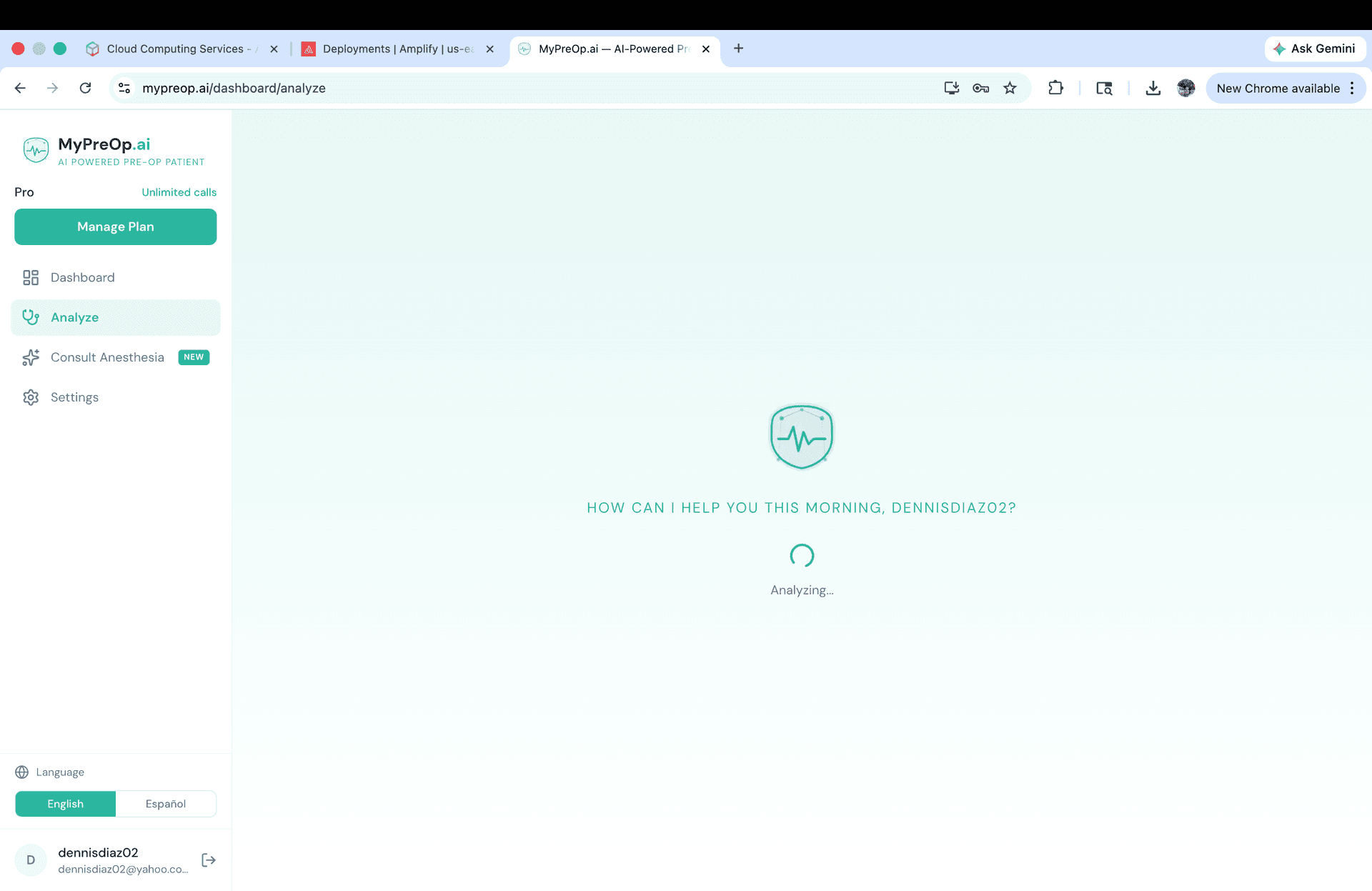
This is the entire wait. About 30 seconds, every time.
What you actually get back
Every clearance produces a HIPAA-compliant PDF you can forward to anesthesia, the patient, or anyone on the care team. Two sections so two audiences read what they need.
Section A — for your coordinator. Section B — for anesthesia.
Have a question about a patient before you book the case?
Ask anesthesia.
Sometimes you're not sure if a patient is a candidate yet. The clearance hasn't been ordered, the workup is half-done, and you're trying to decide whether to put them on the schedule at all. Before VeriOp, your options were: text your CRNA, call an anesthesiologist friend, or just book it and hope.
Consult Anesthesia is the third option. Pull up the patient's chart, ask anesthesia your question in plain English, and get a clinical answer in seconds — with the patient's actual labs, meds, and history loaded into the conversation. It's a real back-and-forth — ask follow-ups, push back, dig into the reasoning — exactly like a phone consult with an anesthesiologist who's already read the chart.
100% HIPAA-protected. The conversation runs on the same AWS HIPAA-eligible backend as the rest of VeriOp, with a signed BAA. Patient data never leaves the protected environment, never trains a public model, and never appears in your browser history.
Real questions surgeons ask it:
- 🩺 “Patient is on Eliquis for atrial fibrillation. I want to do an abdominoplasty in 10 days. When do I have her stop, and does she need a bridge?”
- 🩺 “BMI 42, snores, never been worked up for sleep apnea. Can I still do this BBL in my office or do I need to send her for a sleep study first?”
- 🩺 “A1c is 8.4. Patient wants a tummy tuck. Do I optimize her first or is this a hard no?”
- 🩺 “GLP-1 agonist for weight loss — semaglutide. Surgery scheduled in 14 days. How long do I hold it, and is there anything else I need to watch?”
You're not paying $299 a month for a clearance tool. You're paying $299 a month for a clearance tool plus an anesthesia consult any time you want one, on every patient you're thinking about operating on — for your whole practice, up to 10 users.
Patient has no clearance at all?
Send them to us.
No PCP. From out of town. Surgery in ten days. Every practice knows this patient. Instead of scrambling, send them a link: a licensed provider completes the medical clearance via telehealth — from $200, done in days, not weeks.
And unlike a generic telehealth letter, it's reviewed on the same platform your anesthesia team uses — cleared by the team that would otherwise cancel you, so it holds up on surgery day.
See the clearance serviceI didn't want to launch with marketing claims.
I launched with a study.
Across 1268 real clearances reviewed by VeriOp.ai, the platform flagged 123 cancellations and 209 same-day delays that would have cost a center between $348K and $840K based on per-case cost data from Dexter et al, ASA/APSF, and Argo et al. Mid-cost weighting puts total savings around $1.69M.
The math is not subtle.
Surgeon Practice plan: $299/month — up to 50 clearances a month for your whole team, up to 10 users.
One prevented cancellation ($5,800–$14,000 per cancelled case) covers months to years of the subscription, depending on your team size.
Most plastic-surgery practices we've talked to are running 3–8 cancellations a year that traced back to clearance issues. At even one a year prevented, the ROI isn't a question.

Dennis Diaz, CRNA
Founder, VeriOp.ai
Why a CRNA built a clearance tool for surgeons
Hi 👋 I'm Dennis Diaz, CRNA. I cover anesthesia for private-practice surgeons in Florida — plastic, cosmetic, oral, GYN. I built VeriOp.ai because I kept walking into cases where the clearance didn't actually clear the patient: missing labs, six-month-old EKGs, a GLP-1 still on board, a hemoglobin in the eights.
My first paying customers are the surgeons I cover. They use VeriOp before every case — I'm not their salesperson, I'm their CRNA, and they pay me to tell them the truth about who's safe for surgery. VeriOp is just that, automated, applied to every chart instead of just the ones I get my hands on.
If you try it and it doesn't help you, call me. My number is at the bottom of this page. I read every flagged miss personally.
What surgeons using VeriOp.ai are telling us
Dennis has created an amazing, practical tool that helps my surgical coordinators be more efficient. It has already helped me avoid several same-day cancellations — not to mention decreased administrative burden. I highly recommend it: one prevented cancellation pays for a full year of the service.
“I process all of my patients through the AI screener and use Chat with Anesthesia during consults — so far it has delivered every time. I used to have two coordinators doing this work; now I'm down to one, and the other focuses on sales. Safety is my number one concern, and I know nothing is missed — AI, myself, and anesthesia all review clearances on the date of surgery. It has not failed.”
— Dr. Puyana, Puyana Plastic Surgery
“Our response time to patients has improved night and day. Before, we had to wait until the doctor was out of the OR. Now we process clearances through VeriOp.ai and get a direct response — 'Cleared' or 'Cleared with conditions' — so we can tell the patient in real time if they need additional workup. Workflow and efficiency, 100%.”
— Gentera Plastic Surgery
“VeriOp.ai has helped us save money by cutting hours paid to staff. We used to ask anesthesia to arrive an hour early to pre-op patients; now we ask for 30 minutes — saving us thousands per month. The app produces a ready-to-go Pre-Op Form for every patient we analyze. It pays for itself. It's a win-win.”
— AERES Plastic Surgery
Simple. No demo calls. No “contact sales.”
Month-to-month. Cancel anytime. No annual contract.
Surgeon Practice
Up to 50 clearances a month. Whole team up to 10 users included — the full platform for your practice
- 50 AI clearances a month · whole team up to 10 users
- Need more this month? Add a pack of 25 for $99 in-app, anytime
- Chat with Anesthesia (chart-aware Q&A)
- Auto-populated Pre-Op Forms
- Practice branding on every form
- Facility-wide analytics dashboard
- Full activity log + CSV export
- Dedicated account manager
- Onboarding session
- BAA available
One prevented cancellation pays for a full year of Surgeon Practice. The math is not subtle. · Need 11+ users? Email Dennis.
Frequently asked questions
Is VeriOp.ai HIPAA-compliant?+
What documents does it review?+
What does the report look like?+
Does it diagnose? Does it replace clinical judgment?+
Who validated this?+
What if it gets one wrong?+
Run your next clearance through VeriOp before anyone else looks at it.
About 30 seconds per patient. If it catches one thing your coordinator would have missed, VeriOp paid for itself a thousand times over.
Start nowPrefer to see it first? Book 15 minutes and I'll run one of your real cases with your coordinator.
Or call/text me directly — Dennis Diaz, CRNA — (415) 650-0748 · dennis@veriop.ai